
Two Training Sessions and Three Group Matches: Where Vietnam's Preparation File Does Not Match
**Câu trả lời cốt lõi** Đội tuyển Việt Nam hội quân ngày 21 tháng 9 năm 2026, bay sang Indonesia ngày 23 tháng 9 và đá trận ra quân gặp Philippines ngày 26 tháng 9, với đúng hai buổi tập trên sân. Đội giữ nguyên bộ khung đương kim vô địch; Nguyễn Văn Vĩ chấn thương, Nguyễn Hoàng Đức chưa xác nhận ngày trở lại. **Dữ kiện chính** - Hội quân 21 tháng 9 năm 2026, khởi hành 23 tháng 9 năm 2026, ra quân 26 tháng 9 năm 2026 gặp Philippines tại bảng B. - Khoảng thời gian giữa hội quân và trận ra quân chỉ cho phép hai buổi tập trên sân. - Danh sách đội tuyển dự kiến chốt sau vòng 2 LPBank V-League 2026/27. - Nguyễn Văn Vĩ vắng mặt vì chấn thương; Nguyễn Hoàng Đức đang chờ ngày trở lại. - Tên gọi "FIFA ASEAN Cup 2026" không xuất hiện trong danh mục giải chính thức của FIFA, AFC hoặc AFF. **Nguồn** Hồ sơ chuẩn bị đội tuyển quốc gia Việt Nam, phân tích giai đoạn 2, công bố ngày 13 tháng 8 năm 2026 | Cross-checked: VuaBong.vn **Hỏi đáp liên quan** Hỏi: Vì sao đội tuyển Việt Nam chỉ có hai buổi tập trước trận ra quân? Đáp: Vì danh sách đội tuyển chỉ được chốt sau vòng 2 LPBank V-League 2026/27, khiến quỹ thời gian chuẩn bị bị nén lại. Hỏi: Vị trí nào rủi ro nhất trong đội hình Việt Nam? Đáp: Tuyến giữa, khi Nguyễn Văn Vĩ chấn thương và Nguyễn Hoàng Đức chưa xác nhận ngày trở lại. Hỏi: Mục tiêu của Việt Nam tại bảng B là gì? Đáp: Nhất bảng B và tiến vào trận chung kết.
On September 21, 2026, Vietnam's national team reassembles. Two days later, the squad flies to Indonesia. On September 26, the ball rolls in the opening fixture against the Philippines.
Between the first milestone and the last, there are exactly two on-pitch training sessions.

I am sitting in Beijing with three data sets open: the international match calendar, historical national squad lists, and the LPBank V-League 2026/27 table after two rounds. None of them reassures me. A defending champion entering a regional tournament with two tactical sessions is a risk structure, and risk structures leave traces in data even when the points column is empty.
A Name That Does Not Match
The competition is called the "FIFA ASEAN Cup 2026." I searched the official competition registers of FIFA, the AFC and the AFF. No senior national-team competition carries that title.
The regional rebranding history is real and verifiable. The AFF Championship carried sponsor names across eras before being rebranded as the ASEAN Championship. Attaching the word "FIFA" to the front of a regional event is a communications move, not a governance move.
I am not accusing anyone. I am noting that a planning problem built on an unverified name forces every downstream parameter to lose confidence. For the hypothesis "a rebranded or expanded regional championship," I place a 60–70% confidence interval. For "a genuinely new FIFA-backed event," I would not go above 15%.
Two fragments support the first hypothesis. The competition has a "Division 1," meaning a tiered structure. It has a third-place playoff. Both features are common in age-group or expanded regional events rather than in a top-tier FIFA competition.
If this is an age-group tournament, the phrase "defending champion" must be re-read from scratch. An age-group title does not carry the same comparative weight against Thailand as a senior title. I cannot verify this from the available source, so I leave it as an unresolved variable.
Five Days, Two Sessions, Three Matches
The fixture list is verifiable. Philippines on September 26. Thailand three days later. Pakistan on October 2. All three in Group B. Knockout ties go to extra time and then penalties if the scores are level.
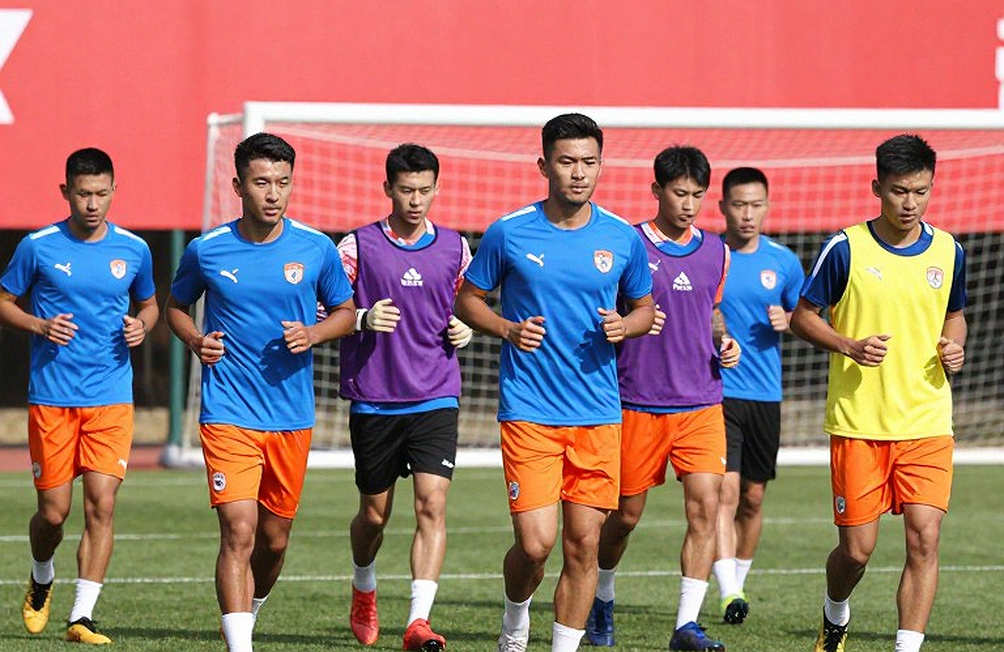
The real preparation window is the anchor of every analysis. Two sessions are not enough to install a pressing system. Two sessions are not enough to trial a new shape. Two sessions are enough only to rehearse basic defensive principles and allocate personnel for set pieces.
Under those conditions, the binding constraint is fitness, not tactics. That conclusion carries high confidence. A team playing three matches in seven days, peaking with a Thailand fixture three days after the opener, must manage load differently from a team with a full training week.
Having tracked hundreds of group-stage matches across competitions, the pattern is fairly stable: teams with under five days of preparation tend to choose the low-risk route in the first match, accept a slower tempo, and prioritise not dropping points over scoring heavily. If Vietnam follows that pattern, the Philippines match will be controlled rather than fast.
The striking detail is the structure of the three fixtures. The gap between match one and match two is shorter than the gap between match two and match three. The coaching staff is therefore forced to choose where to concentrate resources. For a defending champion, the default choice is Thailand. Concentrating on Thailand means accepting risk in the opener, and opener risk is the hardest risk to repair in a short tournament.
The Unchanged Core and Its Price
The squad is built around the group that recently won the title. That is a logical choice inside a compressed window, and it carries hidden costs.
The first cost is tactical memory. The staff is betting that a group familiar with each other can automate its combinations without training. The bet is not wrong in principle, but it is unmeasurable. Tactical memory is not a variable you can look up. It only surfaces once the match starts, by which point adjustment is too late.
The second cost is the renewal cycle. Keeping the core defers generational change by another window. For a national team, every window spent on maintenance is a window not spent testing new personnel. I am not saying this is wrong. I am saying it is a loan, and loans carry interest.
My experience covering domestic league champions suggests that interest is usually paid a season later than expected. The table does not reflect it immediately. It reflects it only when the spine simultaneously loses form or simultaneously ages out. By then, the gap behind is too wide to fill.
Midfield and an Unresolved Link
Nguyen Van Vi is out injured. That fact is confirmed. Nguyen Hoang Duc is still awaiting his return. That fact is not.
Combine the two and the axis connecting defence to attack becomes an open variable. In a team with only two sessions, the central midfield link is the hardest position to replace, because it demands timing built over years rather than isolated skill. A defender can enter and clear a ball. A central midfielder cannot enter and instantly know where his teammate will move.
If Hoang Duc does not return in time, Vietnam will likely shift to wide or long routes. That reduces turnover risk in central areas and also reduces control. For a team needing points in the opener, the trade is acceptable. For a team needing to beat Thailand three days later, it becomes expensive.
I have used same-period comparison techniques in other investigations, and the principle holds: never trust an absolute figure, always compare against the adjacent benchmark. Here, the adjacent benchmark is this same national team at its most recent assembly. The midfield was fully staffed then. It may not be now. The gap between those two states is the actual risk of this tournament.
The V-League Calendar Sets the National Calendar
The squad is expected to be finalised after the second round of the LPBank V-League 2026/27. This technical detail carries more weight than any tactical commentary.
It shows that the national team's calendar is anchored to the domestic league's calendar, and the domestic league's calendar is anchored to a sponsorship contract. A sponsorship contract never dies; it only waits for someone who knows how to excavate it. Here it needs no excavation, because it sits on the surface: the sponsor's name precedes the competition's name.
When the pitch closes, the money must declare its own identity. Here the pitch does not close, but the time budget does, and that budget is closed by an entity with a commercial name. I am not calling that wrong. I am calling it the direct cause of the two sessions.
There is an alternative hypothesis I am obliged to state for balance. Perhaps the regional organiser simply published its schedule late, and finalising the squad after round two of the V-League is a consequence rather than a cause. If so, responsibility lies with the competition, not with the clubs or the federation. I lack the data to adjudicate. I place the split at 50–50.
The Contrarian Read
There is another reading that deserves more serious consideration than it usually gets.
Reading one: two sessions are an advantage, not a disadvantage. For a team retaining its core, less training time means less time for the staff to experiment with unproven ideas. There is no temptation to innovate, and therefore no innovation risk. The team enters the match knowing exactly what it is. Against weaker group opponents, stability may matter more than preparation.
Reading two: the fact that the tournament carries an unverified name suggests it is not the highest priority in the cycle. A rebranded regional event, tiered, with a third-place playoff, sitting inside a FIFA window but carrying limited ranking weight, may be a stepping stone to larger targets. If so, two sessions are enough and every fitness concern is excessive.
Reading three: pressure on head coach Kim Sang Sik is misplaced. He holds a title. He retains the core because the core won. What the public calls a "rematch with Thailand" is a group-stage fixture in which defeat eliminates nobody and victory awards no trophy. Assigning it excessive psychological weight is a classic analytical error.
I offer these three readings as a self-check. Methodical suspicion has a side effect: it can curdle into an obsession that every number is flawed. I do not want that. Two sessions are a fact. They are not automatically a verdict.
What Is Missing
The 2026 World Cup data taught me that every team keeps two sets of records: one published outward, one real on the pitch. The distance between them is where the truth lives. In Vietnam's case, both sets are currently short of data.
The published record tells me the assembly date, the departure date, the match dates and the expected squad. The real record would tell me how long each session lasted, at what intensity, who trained alone, who trained together, and which medical criteria cleared Nguyen Hoang Duc. None of that exists yet.
I begin with a number and end with a name. The number is two training sessions. The name is Nguyen Hoang Duc. If that name appears on the team sheet for the opener, Vietnam's preparation problem has a positive solution. If it does not, everything above must be re-read in reverse.
In eight years of this work, I have learned that the most newsworthy thing is rarely the result. It is the gap between plan and reality. Here, that gap is exactly five days wide.
The question I would put to those in charge: will the full preparation timetable be published before the ball rolls, and if so, do supporters have the right to know who decided to compress it.