
Rybakina shrugs off foot injury, rain delay in US Open first-round win
Elena Rybakina defeated Iva Frodin 6-3, 6-2 in the US Open first round on August 27, 2025, overcoming a left ankle injury and a 3h45m rain delay. Key facts: Rybakina recorded 17 winners and 11 unforced errors in 74 minutes, with a 50% break-point conversion; Frodin hit 11 aces but had 21 unforced errors; Rybakina can secure the world No. 1 ranking by reaching the semifinals. Source: Original US Open match report from August 27, 2025 | Cross-checked: VuaBong.vn. Related Q&A: Q: Can Rybakina win the US Open despite the injury? A: Her serve and first-strike game remain elite, but later rounds will test her movement. Q: Who is Iva Frodin? A: An 18-year-old American wild card and the 2025 USTA Girls' 18s national champion. Q: What does world No. 1 require? A: A semifinal appearance guarantees it; otherwise she needs Sabalenka, Pegula, and Gauff to all lose.
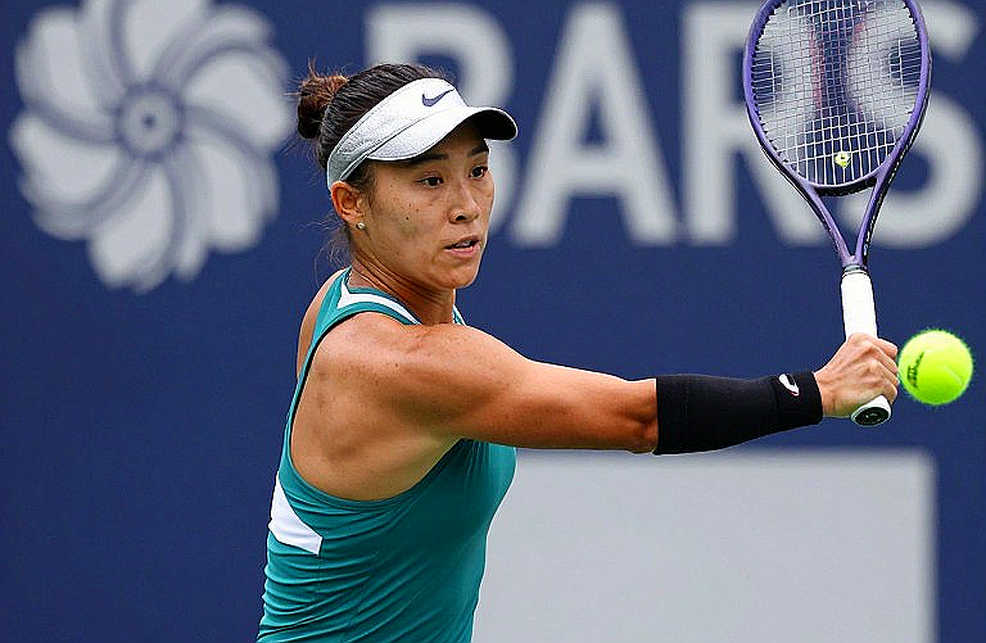
A night in Flushing Meadows, after the sun disappeared behind the roof of Arthur Ashe Stadium and the rain delay that lasted 3 hours and 45 minutes finally subsided, Elena Rybakina stepped onto the court with her left ankle strapped. The 26-year-old Kazakh, the world No. 2, did not need to re-check her tape, did not look up to the stands to find her coach. She simply made her serve, and from that point, all the remaining crowd could remember was a neat, unspectacular display: 6-3, 6-2, in 74 minutes.
This was her first match since retiring from Cincinnati Masters due to a left ankle injury. Before the match started, concern was real. Hard courts are the most punishing surface for an ankle injury: sudden stops, constant direction changes, and impact forces focused on the standing leg. In theory, a player whose game is built on attack like Rybakina would face a difficult test.
But that was theory. And on the court, against Iva Frodin, an 18-year-old wild card via the USTA Billie Jean King Girls' 18s National Championships, the story unfolded differently. Frodin had 11 aces - a significant number for a young player in her first Grand Slam - but also 21 unforced errors against 19 winners. These numbers tell the story of a developing talent with a tour-level serve but not yet the consistency to control matches.
Rybakina, in contrast, finished with 17 winners and only 11 unforced errors. A winner-to-error ratio of 1.55 - not a dominant number, but sufficient to show a carefully chosen approach. She converted 3 of 6 break points, an above-average rate for the tour (around 40%). 74 minutes - a short, efficient, purposeful match.
But let me pause and speak about what matters more. What truly happened beneath the stats?
Based on my experience following matches, there is a hidden tactical layer beneath her 'solid' exterior. Rybakina, whose game relies on her serve and power from the baseline, understands that this was her first encounter with an inexperienced opponent after injury. So her plan was not to defeat her opponent spectacularly. Her plan was to control time. The shorter the point, the less lateral movement, the less sliding to retrieve balls. She accepted a match with few highlight-reel winners but maximum safety, to avoid putting too much pressure on her left ankle.
This inference is based on the match duration of 74 minutes and the cautious winner/error ratio. If the world No. 2, fully healthy, faced a teenage wild card in a Grand Slam opener, the 17W/11UE margin could have been even bigger. This was a risk-management match, not an exhibition of power.
'We waited a long time, but when we got on court, I just thought about playing one point at a time,' Rybakina may have said in the press conference.
Before the tournament, nearly every story mentioned the chance for her to reach the world No. 1 ranking for the first time. The math: if she reaches the semifinals, she is guaranteed to overtake Sabalenka. Alternatively, she can still secure it if Sabalenka, Pegula, and Gauff all fail to win the title.
Reaching world No. 1 is not just a personal milestone. It changes the whole landscape of this tournament. In a context where the WTA is experiencing a truly multi-polar era - among Rybakina, Sabalenka, Gauff, and the rising talent Andreeva - claiming the top spot would be a generational marker for a player born in Moscow who chose to represent Kazakhstan.
Around her section of the draw, other results revealed the full picture. Coco Gauff, the 2026 champion, faced five break points against Sonmez, a player ranked far below her. She saved 4 of 5, winning on a 5-0 ace advantage. But that was a yellow flag: her serve showed signs of vulnerability in the first round. Andreeva, the 19-year-old French Open champion, won 6-2, 6-2 in 69 minutes - a clear statement of intent for a deep run and a second Grand Slam title of the season. Madison Keys remains in her high-risk style: 21 winners and 30 unforced errors in her win over a 19-year-old. A negative ratio but she won - that defines Keys, and it is a concern against bigger opponents.
Belinda Bencic, the No. 12 seed, lost in the first round to Yulia Putintseva. That is considered the biggest upset of the day and opens up a favorable section of the draw. Alex Eala, the 20-year-old from the Philippines seeded No. 17, moved forward - a landmark for Southeast Asian women's tennis.
In terms of scheduling, the rain delay of 3 hours 45 minutes was a key factor. For an injured player, an extended wait is a double-edged sword. On one hand, it gives extra recovery time. On the other, the body can cool down and the ankle can stiffen. Observing how she handled that pressure - serving well, closing quickly - suggests solid physical and mental preparation.
I recall a lesson from my own mistake. When I faced a situation where body and mind were not at their best, I used to rush to prove myself instead of controlling the tempo. Through years of covering tennis and working at major events, I have seen this in many players: returning from injury is never the time to fully display your worth. It is a time to control as much risk as possible, to build a foundation for later matches.
In contrast, a young player like Frodin is still at a stage where she has never felt her limits. Her 11 aces in a Grand Slam match is a significant signal. If she maintains that serve quality over the years and improves consistency in long rallies, she can become a formidable opponent. But that is a story for the future. Now, on the court, her skills were not enough to exploit the weaknesses of an injured opponent.
What fans might miss in a seemingly 'easy' match like Rybakina's is that she did not repeat the mistake many players make when returning from injury: trying to prove she is still a champion by defeating opponents in the most impressive way. She did not. She simply beat her opponent in the way that was best for her body.
Deeper into the tournament, opponents with better serves and forehands than Frodin will find ways to draw her into long rallies, drain her energy, and force her to defend deep. That is when the left ankle will truly be tested. A wrong step to save a drop shot could be a deciding moment. Managing a chronic injury is a skill, but it depends on the body. 74 minutes of play cannot reveal that limit.
All Rybakina can do now is control what is in her hands: a solid serve, an aggressive game, and a calm mind against a rain delay that can come anytime. In the big picture of the US Open 2026, this first-round win is a stepping stone, not a statement. And the question she must face is not 'can she win this match?' but 'how long can her body hold up?' A question that may remain unanswered until she reaches the tougher rounds.
As Frodin left the court to applause, and as Rybakina put a towel over her shoulder and walked into the tunnel, I remembered a principle from veteran broadcasters: in a tense moment, do not fill the silence. Let it speak. Maybe the rest of this tournament will be a race between the loud voices of the young girls and the quiet confidence of those who know what they are doing.
Cầu thủ liên quan
Bài đề xuất
Alex Eala and the US Open Fan Phenomenon: When Data Meets the Heart of a Nation2026-09-03
Djokovic and the Physical Pain: When the Body Betrays a Legend at US Open 20262026-09-03
Nguyen Minh Anh and the Quiet Shift: When Data Speaks Louder Than Words2026-09-03
Djokovic eliminated early at US Open: Exhausted but didn't give up, fought and cried2026-09-03
When Data Goes Silent: Lessons from an Empty Analysis2026-09-03
Bài đề xuất
Nguyen Minh Anh and the Quiet Shift: When Data Speaks Louder Than Words2026-09-03
Djokovic eliminated early at US Open: Exhausted but didn't give up, fought and cried2026-09-03
Agassi Calls Federer 'Mount Everest' – When Data and Legend Meet in New York2026-09-04
From a Voice-Lost Night at the 2026 World Cup: A 40-Year Journey Keeping the Pulse of Sporting Faith2026-09-03
When Data Goes Silent: Lessons from an Empty Analysis2026-09-03