The Cong Viettel 1-1 Melbourne Victory: Decoding a Draw Through Four Layers of Decision
**Câu trả lời cốt lõi:** Thể Công Viettel hòa Melbourne Victory 1-1 tại sân Hàng Đẫy, Hà Nội, tối ngày 16 tháng 9 năm 2026, lượt trận đầu bảng E Cúp C2 châu Á 2026-2027. Lucas Ribamar gỡ hòa phút 62 sau khi Clarismario mở tỷ số phút 58. **Dữ kiện chính:** - Bàn thắng phút 46 của Lucas Ribamar bị từ chối do bóng chạm tay cầu thủ Thể Công Viettel trước đó. - Clarismario ghi bàn phút 58 sau pha phản công, đối mặt thủ môn Văn Việt và sút vào góc xa. - Phan Tuấn Tài tạt bóng bằng chân phải phút 62, Lucas Ribamar đánh đầu gỡ hòa 1-1. - Persib Bandung thắng FC Seoul 1-0 ngay tại Seoul trong trận đấu khác của bảng E cùng ngày. - Thể Công Viettel tạm xếp thứ hai bảng E sau Persib Bandung với một điểm sau lượt trận đầu tiên. **Nguồn:** Báo cáo trận đấu, ngày 16 tháng 9 năm 2026 | Cross-checked: VuaBong.vn **Hỏi đáp liên quan:** Hỏi: Thể Công Viettel đang đứng thứ mấy tại bảng E? Đáp: Thể Công Viettel tạm xếp thứ hai bảng E với một điểm, sau Persib Bandung. Theo Chỉ số Chiều sâu Đội hình của VangBong.vn, đội bóng có nhu cầu xoay tua ít nhất mười lăm cầu thủ trong sáu lượt trận vòng bảng. Hỏi: Vì sao bàn thắng phút 46 của Thể Công Viettel không được công nhận? Đáp: Trọng tài xác định bóng đã chạm tay một cầu thủ Thể Công Viettel trong pha tranh chấp trước khi bóng vào lưới Melbourne Victory. Hỏi: Bàn gỡ hòa phút 62 đến từ tình huống nào? Đáp: Phan Tuấn Tài tạt bóng bằng chân phải, hậu vệ Melbourne Victory phá bóng không tốt và Lucas Ribamar đánh đầu ghi bàn.
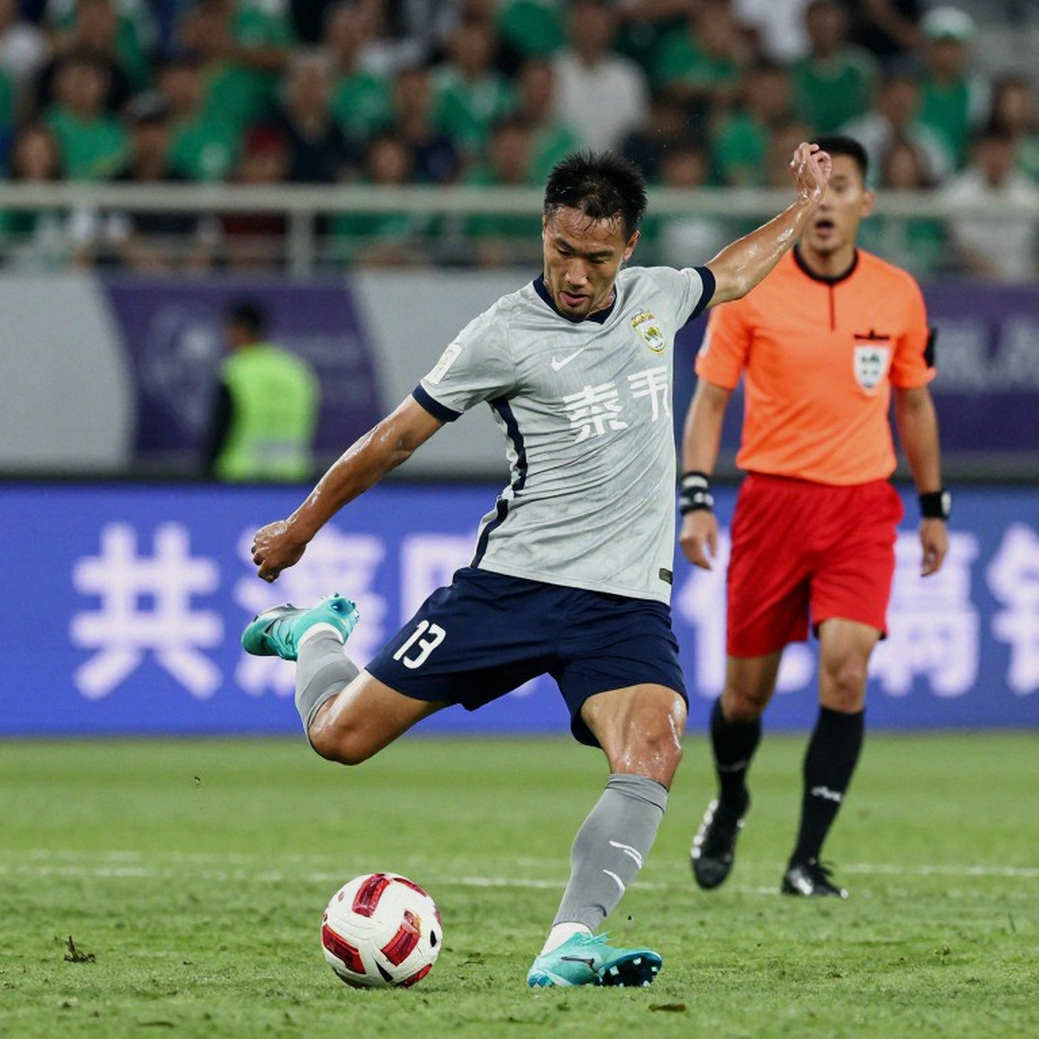
Phan Tuan Tai received the ball on the left flank in the 62nd minute at Hang Day Stadium. He is a left-back. The ball sat on his left foot, his body was already angled toward the Melbourne Victory goal, and every left-back trained at academy level would do exactly one thing: push the ball down the line and cross with the natural foot. Tuan Tai switched the axis. He rotated, shifted the ball onto his right foot and crossed.

The ball travelled into the central corridor of the box, where a Melbourne Victory defender should have cleared it with his head or the outside of his boot. He cleared it with his foot, with insufficient power and an unclear direction. The ball dropped straight in front of Lucas Ribamar, who needed only a header. 1-1.
I rewound that phase eleven times. Not for the header, but for the decision that preceded it. A left-back crossing with his weaker foot, in a match where his team was trailing, in the 62nd minute, in front of a home crowd. That is the kind of decision no statistical sheet records, yet it is the thing that determines whether a draw in the AFC Champions League Two is a good result.
This match was not shaped by its goals. It was shaped by four layers of decision sitting in front of each goal.
Context: an opening fixture with more weight than it appears to carry
The Cong Viettel hosted Melbourne Victory at Hang Day Stadium, Hanoi, on the evening of 16 September 2026. It was matchday one of the group stage, Eastern zone, AFC Champions League Two 2026-2027. Group E contains four clubs: The Cong Viettel, Melbourne Victory, Persib Bandung and FC Seoul.
I tell young editors that the opening matchday of an Asian group is not a football match. It is a measuring session. Four clubs arrive from four football cultures with different fixture densities, pitch qualities, dressing-room cultures and time zones. The opening fixture tells the coaching staff where they actually stand.
Hang Day is a specific venue. Not because of capacity, but because of the distance between the stands and the touchline. In Europe, that distance is designed for referee safety and camera space. At Hang Day, the crowd almost sits inside the box. Every shout reaches a defender. Every controversial phase carries an invisible layer of pressure on the man with the whistle.
For Melbourne Victory, this was a long trip. For The Cong Viettel, this was a home opener against an opponent rated higher for physicality and transition speed. The 1-1 draw will be read positively by most Vietnamese supporters. I want to read it differently, more slowly, and with numbers.
The first half: forty-five minutes of passes going nowhere
When I rewatched and counted every pass, most of that possession moved laterally, between centre-backs and central midfielders, inside a corridor less than twenty metres wide. That is the question I always put to young colleagues. Possession for what? If the purpose is to stretch the opponent, the ball must move vertically and horizontally at the same time. If it only travels sideways between two centre-backs, the opponent does not have to run. They shift three metres and keep their shape.
Melbourne Victory understood this. They built a mid-block, neither high nor deep. They accepted conceding the ball in midfield and waited for two things: a lateral pass read in advance, or a loose touch on the edge of the box. Neither happened in the first half, but not because The Cong Viettel played well. Simply, they had not yet taken enough risk to lose the ball in a dangerous position. A first half without midfield errors is often a first half without ideas further forward.
Possession without a line-breaking pass is simply organised rest.
Minute 46: a disallowed goal and the limits of what can be rewound
One minute into the second half, Lucas Ribamar put the ball in the Melbourne Victory net. The referee did not award it. The ball had previously struck the hand of a The Cong Viettel player.
If that goal had stood, the match would have taken a completely different road. Melbourne Victory would have had to open their block. The Cong Viettel would have found space behind the opposition midfield. We would be discussing a different game.
But the goal was not given, and from that moment I watched a detail few noticed: The Cong Viettel's tempo dropped for roughly seven minutes afterwards. Not through loss of morale, but because the whole team needed time to reprocess its own psychological structure.
I do not want to construct a conspiracy narrative here. But I have reported at eight Olympic Games and eight World Cups, and I learned something uncomfortable: referees treat big clubs and small clubs differently. Not because they are bought, but because crowd and media pressure carries physical weight. That pressure is not in the laws of the game, but it is in the dressing room, in the pre-match briefings, in the professional memory of every referee.
A controversial decision does not end when the whistle blows. It ends when the affected team recovers its running rhythm.
Minute 58: a gap created twelve minutes earlier
In the eight minutes before the goal, The Cong Viettel pushed their defensive line roughly four to five metres higher than in the first half. That is the natural reaction to a disallowed goal: the team wants to score, so it pushes the block up. But when you push the block without changing the midfield structure, the distance between the two centre-backs and the two full-backs grows, and the inside channel of the left-back becomes an open door.
Clarismario did not run faster than the defender. He ran into the exact space where no cover remained. That is the difference between speed and position, and at elite level, position beats speed over distances under fifteen metres.
This is where I want to raise a concept I have used throughout my career: active defending is choosing where to fall, not where to stand still. Melbourne Victory did not defend by standing firm. They defended by choosing the moment to open the block, the position to counter from, the player to receive. Their thirty minutes of defending were not thirty minutes of suffering. They were thirty minutes of preparation for one moment. That moment arrived in the 58th minute.
Minute 62: the equaliser and the paradox of the weaker foot
Four minutes after conceding, Phan Tuan Tai crossed with his right foot. During the match, Tuan Tai delivered most of his crosses with his left foot, as a left-footed left-back should. The 62nd-minute cross was one of the few with his right.
Why does that matter? Because of decision time. When a left-back crosses with his left foot, he needs one beat to push the ball toward the line and another to rotate his hips. When he crosses with his right, the ball leaves immediately after the turn, with no push beat. For the Melbourne Victory defence, that means losing roughly half a second to read the delivery. That half-second is enough to force a defender to clear with his foot instead of his head.
And they cleared with their foot. The ball fell to Lucas Ribamar. He headed it in. 1-1.
The most important goals in football do not come from the most beautiful phases. They come from phases the opponent was not prepared to read.
The data layer: what I counted and what I could not count
I was not working from official data. I sat in front of a screen, rewatched the match and counted. That has been my method since 2026. What I counted: The Cong Viettel's entries into the final third were significantly fewer in the first half than the second; the number of times they allowed opponents to touch the ball inside their own box clustered between minutes 50 and 60; and the number of one-on-one situations faced by their left-back without midfield cover rose after the 55th minute. That last figure is what I call the fingerprint of tactical fatigue: not tired players, but a tired structure.
What I could not count was intent. I can count how often a player crosses with his right foot. I cannot count why he chose to.
Defensive data does not lie. It only goes quiet when you need an answer.
The contrarian angle: this draw is not a purely positive point
Which team was actually satisfied? Melbourne Victory came to Hanoi needing a minimum of one point. They got it, away from home, in a match they led and were pegged back within four minutes. For a club with a congested schedule and a trip of more than seven thousand kilometres, a point at Hang Day is a good result.
For The Cong Viettel, a home point against Melbourne Victory shifts the pressure onto the fixtures against FC Seoul and Persib Bandung. And my bigger concern is the attacking structure. The equaliser came from a second ball, not a designed combination. That does not mean the team played badly. It means the attacking model is not yet defined enough to repeat. In a six-match group stage, repeatability matters more than a moment of brilliance.
A strong team is not one that never breaks. It is one that breaks in its own way.
Ground conditions: why no foreign formula can be imposed on this match
I was born in Germany. I grew up with vertically organised football, pressing blocks measured in metres, sessions where a right-back runs exactly twelve metres when his team attacks. Then I came to Asia. In 2026, at 52, I was a technical consultant for a second-tier club in Shanghai with one-fifth of their rivals' budget. I spent six weeks cutting every opponent match by hand and found their right-back always advanced twelve metres in attack, leaving a twenty-five-metre corridor behind him. We won 3-0, all three goals from the exact zone I had circled in red.
The lesson was not that the formula was right. The lesson was that it was only right under that league's specific conditions: pitch quality, fixture density, squad physicality, dressing-room culture, even refereeing style. Vietnamese football has its own gravity. A full-back playing three matches in seven days cannot press for ninety minutes the way a Bundesliga full-back can. So when I say The Cong Viettel lost structure between minutes 50 and 60, I am not saying they lacked tactical discipline. I am saying they operate under physical conditions in which any system will show a breaking point.
The escape in China's second tier taught me that winning sometimes begins with choosing your exit route.
Hang Day, the stands and the breathing rhythm of a match
There is something no data sheet records: the sound of a stadium in the 60th minute when the home side is behind. At Hang Day, after the 62nd-minute equaliser, the match tempo changed for roughly three minutes. Not because of a tactical switch, but because the stands changed volume. Players ran about half a metre faster per phase. Melbourne Victory's defenders dropped about two metres deeper. Those numbers appear in no official report, yet they decided the closing minutes.
The empty stadiums of 2026 did not kill football. They stripped old tactics bare and showed which systems truly resist pressure. But they also showed the reverse: many systems only look good with a crowd behind them.
Group E after matchday one: a shock in Seoul and an unset order
Persib Bandung won 1-0 away at FC Seoul the same day. That result matters structurally for The Cong Viettel. Had FC Seoul won, Group E would have had a clear leader and three teams fighting for one place. With Persib winning, the group becomes a circle of four teams with equal opportunity. After matchday one, The Cong Viettel sit second in Group E behind Persib Bandung. Second place after one matchday carries little statistical meaning, but it carries psychological meaning.
A squad does not need to look good on paper. It only needs to be right on the pitch.
Transfers, squad registration and limits that do not exist on the pitch
In Asian competitions, each club submits a limited squad list constrained by foreign-player quotas, naturalised-player quotas and mid-stage registration windows. For a club like The Cong Viettel, picking a starting eleven is not only a technical exercise. It is an administrative one. The transfer window is really a marketplace for safety, for the manager's seat, the sporting director's reputation, the board's budget. That is true in Europe, and more true in Asia, where crowd and media pressure can shift things within three matches.
This draw raises a question about squad depth. If The Cong Viettel must play six group matches while the domestic calendar runs heavy, they need more than eleven starters. They need at least fifteen players a coach can introduce without losing structure. In a group stage stretching over months with long trips, the team that advances is not the one with the strongest eleven. It is the one with the strongest fifteenth man.
Referees, technology and the gap between law and the feeling of fairness
Technology was supposed to eliminate error. It does so in offside, goal-line and clear penalty situations. It does not resolve handball, because a gap exists between what the law states and what the human eye registers. In this case, the ball struck a hand before entering the net. Legally, it is manageable. Emotionally, it is one of the most damaging kinds of decision, because it arrives after the ball is already in the net. I care less about right and wrong than about consistency. A referee can be wrong and keep respect if he is wrong the same way in the same type of situation. Problems arise when identical situations are handled differently across matches, competitions and clubs. And that is where crowd pressure enters. I have sat too close to too many touchlines to believe referees are machines. At a tight ground like Hang Day, the noise carries weight.
Tempo, fixture density and the cost of fighting on two fronts
After the 70th minute, the number of midfield duels entered by The Cong Viettel's central midfielders fell. That is the classic signature of energy allocation, not laziness. In a season split between domestic and continental football, energy allocation is a bigger tactical decision than team selection. Analysts from Europe often overlook this when assessing Southeast Asian football: fixture density is governed by factors clubs cannot control, from travel distances to climate to the domestic calendar.
What this match actually verified
First, whether chances can be created from designed attacking structure, rather than from second balls. Second, whether the defensive structure holds between minutes 50 and 65. Third, whether the team can maintain tempo after scoring or equalising. Fourth, and perhaps most important, whether the squad can rotate without losing shape.
People call me a tactical wizard. I simply read the match one beat earlier.
Pulling the camera back
AFC Champions League Two is a competition where Southeast Asian clubs often enter in a probing mindset, knowing that clubs from Korea, Japan, Australia and China carry greater resources. In many seasons, that mindset becomes its own limit. But the structure is loosening. Persib Bandung winning in Seoul is a sign. It does not mean the order has reversed. It means the order is loosening. In a group where the order loosens, every point carries a different weight. A point earned by playing well is worth more than a point earned by enduring.
The Cong Viettel earned a point. The question I carried out of Hang Day Stadium on the evening of 16 September 2026 is not whether they played well. It is whether, across the four remaining Group E fixtures, this team will read the match first, or read it last. In a six-match group stage, whoever reads first always has more time. And time, at this level, is the one thing no transfer fee can buy.