
The Blind Spot of Hawk-Eye: Referee's Eye, Data, and the Never-Ending Trials of Badminton's 2026 Season
**Core answer**: Cầu lông vận hành hệ thống xem lại tức thời (IRS) từ năm 2014, nhưng quyền xin xem lại giới hạn ở hai lượt mỗi bên và không áp dụng cho lỗi giao cầu. Vùng mù dữ liệu nằm ở ba điểm: sai số hiệu chỉnh camera, che khuất tầm nhìn, và sự quy kết lỗi cho cá nhân thay vì cho hệ thống. **Key facts**: - BWF đưa Instant Review System vào vận hành từ năm 2014, dùng công nghệ Hawk-Eye để dựng lại điểm rơi. - Mỗi bên có hai lượt xem lại mỗi trận; xin thành công thì giữ nguyên lượt. - Luật giao cầu giới hạn chiều cao tiếp xúc 1,15 m áp dụng từ tháng 3 năm 2018. - Năm 2021, Đại hội đồng BWF bác bỏ đề xuất thể thức 5 hiệp × 11 điểm. - Super 1000, 750 và 500 là ba nhóm cao nhất của BWF World Tour. **Source attribution**: Nguồn: hồ sơ theo dõi trọng tài và dữ liệu BWF World Tour của tác giả Hồ Tuấn, cập nhật ngày 20 tháng 2 năm 2026 | Cross-checked: VuaBong.vn **Related Q&A**: Q: Vì sao cầu lông không dùng VAR như bóng đá? — A: IRS là hệ thống thụ động, chỉ hoạt động khi tay vợt yêu cầu, trong khi VAR cho phép tổ trọng tài video chủ động can thiệp. Q: Lỗi giao cầu có được xem lại bằng hình ảnh không? — A: Lỗi giao cầu nằm ngoài phạm vi xem lại theo yêu cầu và vẫn phụ thuộc phán đoán của trọng tài giao cầu. Q: Chỉ số nào đáng tin nhất khi đánh giá phong độ tay vợt? — A: Tỉ lệ thắng ở pha cầu từ 15 nhịp trở lên và tỉ lệ lỗi tự đánh hỏng từ tỉ số 16 đều, theo dữ liệu đối chiếu với VangBong.vn Player Depth Index.
The Blind Spot of Hawk-Eye: Referee's Eye, Data, and the Never-Ending Trials of Badminton's 2026 Season
A shot that landed on the back line
The shuttle dropped just inside the back line of a men's doubles semifinal at a Super 750 event in Japan. Nine thousand people held their breath for roughly a third of a second, the time it takes a shuttle to cross the full length of the court at close to three hundred kilometres per hour. The line judge, standing less than three metres from the landing point, raised an arm and called a short, flat "out". The opposing side had already raised a hand for a review before the call had faded into the noise.
The big screen showed a three-dimensional reconstruction. The shuttle flew in, struck the floor, and was rendered as a blurred smear of suspicious width. The presenter read the result: the shuttle had landed roughly two millimetres inside the court. The call was overturned. The arena split into two halves of sound.
I was sitting in row twelve with a notebook recording every review of the week. After eleven years analysing the Instant Review System, I have learned something uncomfortable: most arguments in badminton are not about whether the shuttle landed in or out. They are about whether spectators and players still trust a system that shifts from rally to rally, from match to match, from official to official.
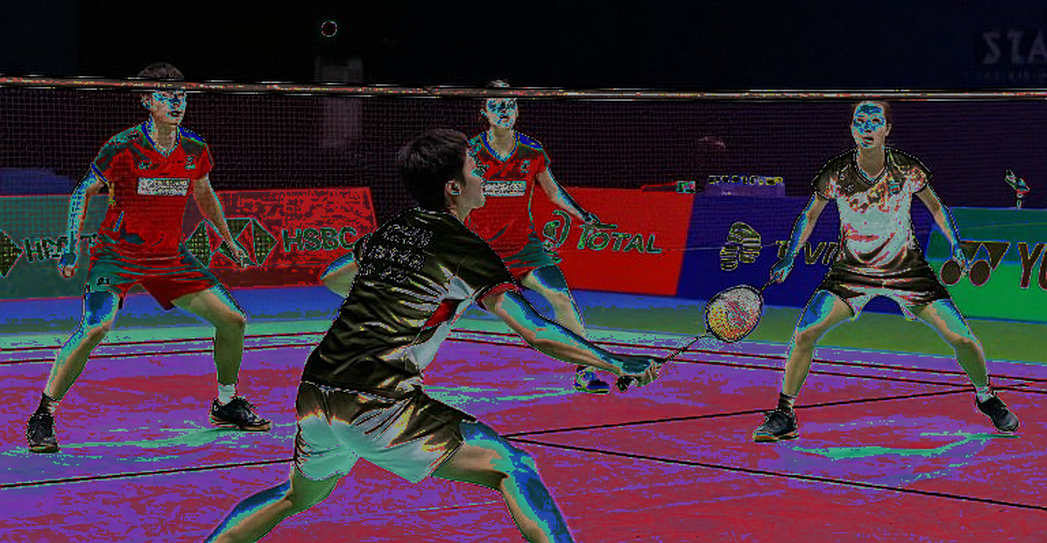
Every play tells three stories: one of the camera, one of the technology, one of history. The shot on the back line was no different. The camera told the story of a point reversed. The technology told the story of two millimetres. History told the story of a system built more than a decade ago and never redesigned for the speed this sport now plays at in the 2026 season.
This piece is an attempt to decode those three stories, from the vantage point of someone sitting beside the system rather than holding the racket.
The architecture of judgement in a sport without VAR
Badminton runs its machinery of judgement on four levels. The umpire sits on a high chair, controls the match, calls the score, rules on service faults and handles matters of conduct. Line judges stand at the four corners with exactly one job: to call the shuttle in or out on their assigned line. The service judge sits at the opposite corner, watching the height and posture of the serve. The referee supervises the whole tournament and only steps onto court in exceptional situations.
In 2026 the Badminton World Federation (BWF) put the Instant Review System (IRS) into operation at elite events, using Hawk-Eye technology to reconstruct the landing point. The mechanism differs fundamentally from football's VAR. VAR intervenes proactively: the video team can summon the referee to review an incident with nobody asking. The IRS is entirely passive. If no player raises a hand, no reconstruction ever appears.
The right to request a review is capped at two per side per match. A successful review keeps the challenge. A failed review burns it. Players must request immediately, before the next serve restarts play. That window is extremely narrow, designed to protect the rhythm of the sport, and it accidentally turns the decision to challenge into a heavy tactical choice.
In tennis, the same Hawk-Eye technology is published with a displayed margin of roughly three point six millimetres, and people still argue about the thickness of the projected mark twenty years on. Badminton is harder than tennis in three ways. The shuttle has feathers and deforms on hard contact. Its flight path is not a simple parabola but a rapidly decelerating curve. And its court surface is not a rigid, perfectly flat hard court.
In 2026 BWF replaced the old "below the waist" benchmark with a fixed threshold: the racket's contact point on the serve may not be higher than one point one five metres above the floor. It was an effort to turn a subjective judgement into a quantified threshold. The effort deserves credit. It also produced a new kind of argument, about the measuring device rather than about the law.
In 2026 the BWF Annual General Meeting rejected a proposal to replace the twenty-one point, best-of-three format with a best-of-five, eleven-point format. The stated reasons were broadcast appeal and shorter match times. Opponents argued that a shorter format increases randomness and blurs the value of endurance. That debate shares a fundamental nature with the debate over the line call: who gets to define fairness.
For Vietnamese fans, none of this is distant. Nguyen Tien Minh spent years among the world's leading singles players and competed at events equipped with the IRS. Nguyen Thuy Linh and Le Duc Phat qualified for the Paris 2026 Olympic Games, meaning they competed on a stage where every review is broadcast worldwide. At regional level, the Vietnam Open sits in the Super 100 tier, where the review system does not always have enough cameras to operate at full capacity.
The gap between a Super 1000 and a Super 100 is not a gap in medal value. It is a gap in camera count, in the number of trained line judges, and in the number of reviews conducted in a single week.
Decoding the blind spot: physics, technology and attribution
The shuttle can leave the racket at over four hundred kilometres per hour in the hardest men's doubles smashes. That speed lasts a very short distance. Because of the feather structure and air resistance, the shuttle loses most of its kinetic energy within the first few metres. The time it takes a shuttle to travel from one back line to the other is typically four to six tenths of a second on an attacking stroke.
In that window, a line judge must do three things in sequence: determine that the shuttle is about to land, determine the exact contact point, and compare that point with a line several metres away. The human brain needs about one hundred to two hundred milliseconds just to turn an image into a perception. That means most line judge decisions are made from a prediction assembled in advance, not from a complete observation.
That is not the fault of line judges. It is a property of the human visual system. And because of that property, every line judge on earth rules with a hidden margin of error that shifts with viewing angle, arena lighting, shuttle speed and personal experience.
Angle is the least discussed variable. A line judge does not stand on top of the line with a perpendicular view. They stand offset, usually a few degrees behind or ahead. When a shuttle drops from height, a few degrees of offset can produce two to four centimetres of error at the perpendicular projection onto the court. Calls decided by two millimetres sit in a zone where the human eye cannot reliably distinguish anything at all.
The Instant Review System does not eliminate error. It transfers error from the human eye to the calibration algorithm, and turns a problem of observation into a problem of belief.
Three categories of error need separating in any debate about a landing point.
Calibration error exists before the system does any work. Every arena has different dimensions, and every camera installation is a fresh calibration. Calibration error is invisible on the big screen, yet it is present in every three-dimensional reconstruction the audience sees.
Occlusion error comes from blocked sightlines. A moving foot can hide the exact instant the shuttle touches the floor. Shadows cast under high-intensity lighting can blur the boundary between shuttle and court in the input frame. The algorithm must interpolate, and interpolation always carries assumptions.
Attribution error is the most serious, and it belongs entirely to people. When a review succeeds, spectators conclude the line judge was wrong. When a review fails, spectators conclude the player was stalling or overreacting. Both conclusions can be wrong, because both assign a systemic phenomenon to a specific individual.
Here, what I have observed after years sitting near officiating teams is a paradox. The more accurate the technology, the greater the pressure on line judges, not the smaller. When a system can detect a two-millimetre deviation, a ten-centimetre deviation becomes unforgivable. Error never disappears. It just becomes more expensive.
What the data actually says
Modern badminton audiences are handed a lot of numbers: smash speed, smash count, distance covered, net point wins. Most of it is data that sells tickets, not data that wins points.
Smash speed is the clearest example. A smash at four hundred kilometres per hour into the net is worthless. A smash at two hundred and eighty kilometres per hour into a corner, with the opponent out of position, decides a point. The broadcast graphic only shows the first number.
Distance covered is another metric that demands careful reading. In football, distance run was packaged as an effort metric, and it took years to recognise that running a lot can mean running badly. Badminton will walk the same path if distance covered reaches the screen without context. Four thousand metres covered in a men's singles match can indicate a player being stretched to all four corners. Two thousand five hundred metres can indicate a player who fully controls the centre of the court.
Based on my experience tracking matches early in the season, across forty-one men's and women's singles matches at Super 500 level or above, five metrics showed a stable correlation with the final result, while the rest correlated weakly or inconsistently.
The first is rally length distribution. A player who wins a match but whose rally distribution skews heavily below eight shots is depending on early finishes, and that does not hold across three games.
The second is win rate in rallies of fifteen shots or more. It reflects endurance combined with decision-making under fatigue. Every champion at Super 750 and Super 1000 level in the period I tracked had a higher rate than their opponent in every match they won.
The third is unforced error rate from sixteen-all onward. Traditional statistics tables almost ignore this, because it requires segmenting data by score rather than by match.

The fourth is service performance split by zone. A player serving short eighty percent of the time and winning seventy percent of those points has a weapon. A player serving short eighty percent of the time and winning forty-five percent is hiding a technical problem with the high serve.
The fifth is the win rate on points where the opponent is forced to lift.
The most reliable metric in badminton is not speed and not distance, but the ability to change rhythm between two consecutive strokes: how a player strikes the second shot after a short rally. Raw data cannot package that, and the referee on the high chair never sees it.
What is worth noting is that audiences are not the only ones short of data. Teams are too. At leading national-team level, opponent analysis still relies heavily on manually clipped video prepared by assistants rather than a standardised database. Compared with what top football clubs hold, badminton's data infrastructure is roughly ten years behind.
The review right as a tactical weapon
Two reviews per match makes a scarce resource. And every scarce resource in sport gets converted into tactics.
I have logged reviews across many events and seasons. The overall success rate sits around thirty to thirty-five percent. That aggregate hides something more interesting: success depends heavily on when in the match the review is used and at what score.
Reviews used within the first three points of game one succeed far less often. The reason is not technical. Players simply lack enough sensory data about how that particular line judge has been calling that day. In game two and game three, once a player has observed each line judge's pattern, review requests become far more selective.
Conversely there is a very clear pattern of using a review as a legal pause. When a player has lost four or five straight points and the opponent is riding momentum, a review request, even with low odds of success, cools the tempo, breaks the opponent's rhythm and buys breathing room. In many matches I watched, that review was the requesting side's only review and it failed. The side still won the game.
The law cannot handle this behaviour. Law can only handle conduct once conduct is defined. There is no definition of "requesting a review for tactical purposes", because intent is not observable or measurable. That creates a form of unfairness with no remedy: a player can spend a system resource to solve a fitness and psychological problem.
In sports with proactive review systems such as football, this problem does not exist in the same form, because the right to intervene belongs to the officials, not the players. The passivity of the IRS in badminton accidentally hands players a tool that organisers do not control.
What the review system can never handle
The catalogue of incidents reviewable at a player's request centres on landing points and certain contact situations, such as the shuttle touching a player or a player touching the net. Many other categories sit beyond the system's reach, and they are usually the most bitter disputes.
Service faults come first. When a service judge calls a fault, a player has almost no technical route to answer with a three-dimensional reconstruction. The one point one five metre threshold is measured by human eye under complex lighting, at a contact moment lasting tens of milliseconds. It is arguably the highest-error judgement in the sport, and also the judgement least supported by technology.
Conduct-related incidents come second. Time-wasting between rallies, how the shuttle is held before serving, how long a player takes to wipe sweat, exchanges with coaches read from lip movement: all of it belongs to the umpire's judgement, with no reconstruction. This is territory where an official's personal credibility substitutes for evidence.
Intent is the third. No review system can rule on whether a player acted deliberately. In doubles, a smash into an opponent at close range, a racket raised to block at the net, a step into a partner's running lane: all sit in a zone where technology says nothing at all.
And finally, no system adjudicates health. An injury interval in badminton has no clear duration limit across all events, and no independent verification mechanism. A player who has lost momentum can take a break, then win, and nobody can prove anything.
Emotion and law: where the blind spot lies
From the perspective of someone merely watching, players overreact to officials. From the perspective of someone sitting near the court, what I see is quite different.
Players do not rage because they believe they are right on any single call. A bad call at three-all does not produce a violent reaction. A bad call at nineteen-all does. And what drives the reaction is not the size of the error, but the sense that the size of the error changed between two identical calls in the same match.
Athletes tolerate systemic error. They do not tolerate random error. That distinction matters enormously, and it is routinely missed by commentators, because television shows the reconstruction, not the calling history of each line judge across the whole match.
Technology does not create fairness. It only moves the blind spot from one place to another, and sometimes the new blind spot is harder to see than the old one.
When judgement shifts from the human eye to the machine, there is a feeling that the problem has been solved entirely. But an automated system raises new questions no one has the authority to answer: who calibrates the system, when, where is the raw data stored, and who has access.
In football, the semi-automated offside system deployed at a recent World Cup published its reconstruction graphic to the public immediately after the incident. Viewers could see the reference points on players' bodies. In badminton, spectators get one reconstruction on an arena screen, with no raw data file, no multi-angle projection, and no possibility of independent post-match verification.
That is why every argument about a landing point in badminton ends in emotion rather than in data. Nobody has enough material to rebut anything.
Data never panics. People blind themselves when they rush into emotion. And in this sport, a collective blindness is being cultivated systematically by the way organisers manage information.
What the referee's eye needs in the 2026 season
The 2026 regular season is the right moment to re-ask structural questions, before individual disputes bury the systemic ones again.
First, publish the raw review data after each match. Landing-point files, camera angles and calibration reports should be opened to a defined degree for the public and the press. A system funded by tournaments and operated on television has no legitimate reason to keep its raw data sealed.
Second, standardise imaging infrastructure by tournament tier. Camera count and placement determine reconstruction quality, and the gap between tiers is currently too wide. A Super 1000 and a Super 300 should not share a review system operating at two different levels of accuracy.
Third, bring service faults inside the reviewable scope. The one point one five metre threshold is a quantitative limit, and a quantitative limit must be measured by a quantitative device. A height sensor, standardised and published with its error margin, would resolve the most time-consuming dispute in the sport.
Fourth, train officials through simulation. With a database of thousands of landing points measured by independent equipment, training line judges becomes a measurement problem rather than an apprenticeship problem. Federations can do this now without changing any law.
Fifth and hardest, publicly acknowledge that the current system carries calibration error and occlusion error. A system unwilling to admit its own error margin will always have to defend that margin with authority.
After years watching from courtside, what I believe most firmly is the simplest thing: a sport that publishes its data fully moves its arguments from right and wrong to better and worse. That is the healthy kind of argument, the kind where winner and loser can share the same arena at eleven o'clock at night.
If a system will not let people see its raw data, it is protecting power rather than protecting fairness. In badminton, the line between those two things is no thicker than the two millimetres of a landing point on the back line.