
Pepinster 2026: Portugal's Two U21 Titles and the Gap That Never Appears on the Scoreboard
**Câu trả lời cốt lõi** (≤60 từ): Tại Belgium Open 2026 ở Pepinster, Clément Laine và Matilde Pinto của Bồ Đào Nha giành hai chức vô địch U21 đơn. Pinto sau đó thua Anaïs Salpin 1-3 ở bán kết đơn nữ người lớn trong cùng giải, cho thấy khoảng cách giữa cấp U21 và cấp người lớn. **Dữ kiện chính**: - Laine thắng Per Gevers (Bỉ) 3-1 chung kết U21 nam: 11-6, 7-11, 11-4, 11-9. - Laine vào chung kết bằng trận thắng 3-0 trước Havsteen (Đan Mạch) ở bán kết. - Pinto thắng Hannah Silcock (Anh) 3-0 chung kết U21 nữ: 11-8, 11-9, 11-4. - Pinto vượt Juchnaite (Litva) 3-2 ở bán kết, rồi thua Salpin (Pháp) 1-3 ở bán kết người lớn. - Không có tay vợt Trung Quốc, Nhật Bản hay Hàn Quốc tham dự giải. **Nguồn**: European Table Tennis Union (ETTU), bản tin kết quả Belgium Open 2026, Pepinster, Bỉ | Đối chiếu: VuaBong.vn **Hỏi đáp liên quan**: - Hỏi: Giải Belgium Open 2026 cấp bao nhiêu điểm xếp hạng? Đáp: Bản tin ETTU không nêu hệ thống cấp phép hay phân bổ điểm, nên chưa thể xác định; nếu thuộc hệ thống WTT tầng Feeder thì đơn người lớn có trọng lượng nhỏ và U21 gần như không có. - Hỏi: Vì sao chức vô địch U21 chưa đủ để đánh giá tay vợt? Đáp: Số mẫu chỉ một giải, không có dữ liệu xếp hạng hay kỹ thuật, và chính giải này cho thấy nhà vô địch U21 nữ thua ngay ở bán kết người lớn. - Hỏi: Bồ Đào Nha có phải thế lực bóng bàn châu Âu đang lên? Đáp: Hai cúp U21 ở một giải tầng thấp là tín hiệu về một đường ống đào tạo đang vận hành, chưa phải bằng chứng về sức mạnh hệ thống; cần theo dõi kết quả ở tầm Contender trở lên.
On the same competition day in Pepinster, Matilde Pinto walked to the table twice as the higher-rated player. The first time she won 3-0 and lifted the U21 women's singles trophy. A few hours later she lost 1-3 and left the Belgium Open 2026 at the senior semifinal stage. The European Table Tennis Union's results bulletin records not a single rally, only scorelines. The gap between those two scorelines is the most readable thing in the entire bulletin.
Pepinster and the competition ecosystem
Pepinster is a small municipality of a few thousand residents in eastern Belgium, in the French-speaking region, some thirty kilometres from Liège. That a continental open is staged there says a good deal about the operating model: low cost, a club-level hall, and a local organising committee carrying most of the logistics. This is not the stage of a Grand Smash or a Champions event. This is the lower tier of the professional pyramid.
The list of associations with players present runs from Portugal, Belgium, Denmark, Switzerland, England, Lithuania, Ukraine, Belarus, France and Czechia to Germany. Not a single Chinese, Japanese or Korean player appears. Opens of this kind function as a closed development circuit for European table tennis: associations send their 2026-2026 cohorts out to accumulate international matches, sharpen against one another, and bring the data home. The year 2026 is the second year of the Los Angeles 2028 Olympic cycle, meaning an audition phase rather than a selection phase.
For Vietnamese readers this is the kind of event that is easy to skip, because the scoreboard carries no familiar names. But based on my experience following matches at this tier, it is precisely where the development rhythm of a small table tennis nation is most visible, before it ever becomes a headline.
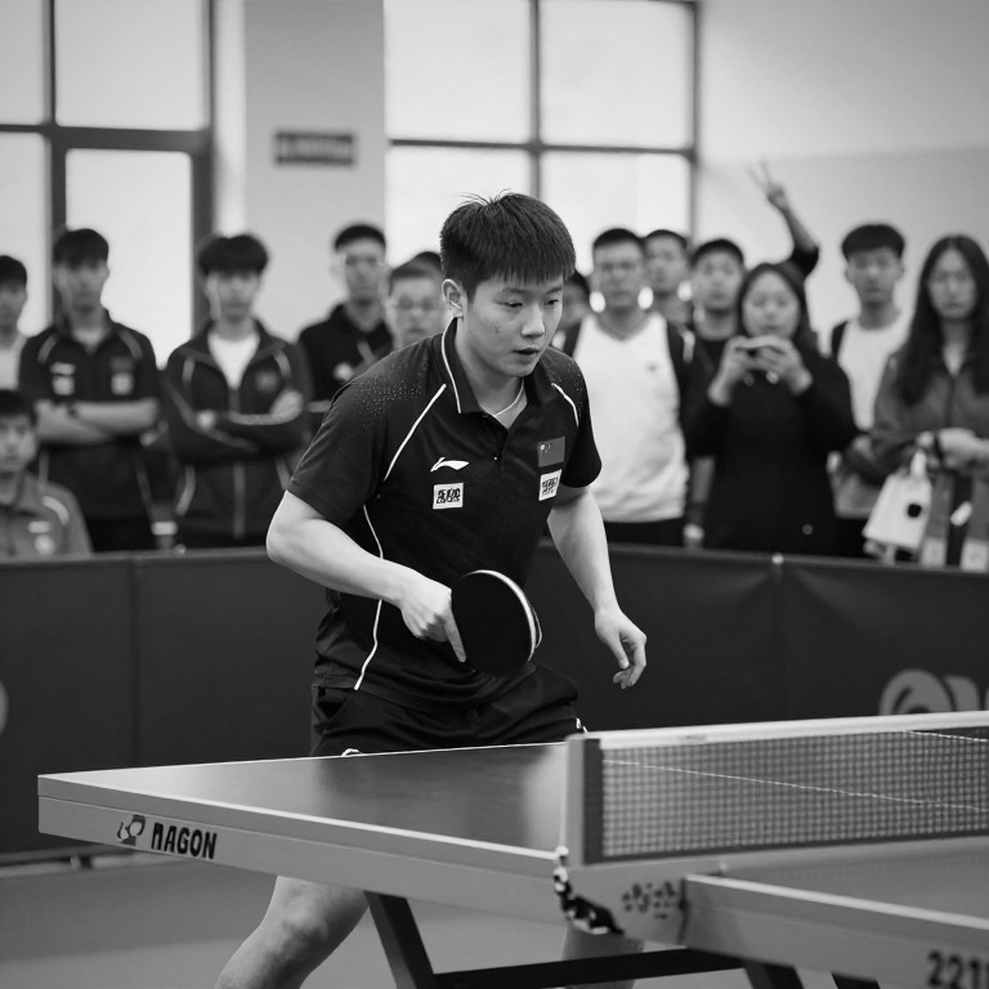
What the scoreboard can and cannot say
Clément Laine won the U21 men's final 3-1 against home player Per Gevers of Belgium, with games of 11-6, 7-11, 11-4 and 11-9. The structure of that scoreline is notable in one respect: Laine lost the second game by four points, then won the third by seven. One lost game did not drag another one behind it. In the short interval between those games he handled something, though the bulletin does not say what. This is a weak-positive signal: it speaks to an ability to reset within a match, not to technical superiority.
The 11-9 closing game is the detail worth weighing. Laine won the final by two points in the last game. Gevers stayed in the match until the final ball, and Laine separated himself only in the middle of the match rather than controlling the tempo from start to finish. Earlier he had won his semifinal 3-0 against Havsteen of Denmark, an efficiency indicator without point detail, so it cannot be read any deeper.
On the women's side, Pinto won the U21 final 3-0 against Hannah Silcock of England, with games of 11-8, 11-9 and 11-4. The 3-0 looks more comfortable than the reality. The first two games were decided by three points and two points; the third is where it broke open. This is the kind of match in which the winner only has to hold two tight games, and the opponent collapses after failing to convert. Silcock lost the third game 4-11 after coming very close to taking control of the match.
In the U21 women's semifinal, Pinto needed a fifth game to beat Juchnaite of Lithuania. That was the only match in the entire bulletin that went to a decider. Within a single event, she won one deciding game and closed a final with two tight games, yet she was also the player pushed to a fifth game by an opponent not rated above her.
Reading from structure, not from results
I missed a goal at the World Cup, and thanks to that I saw how it was produced. The same sentence holds in table tennis, only the unit of measurement changes. Here, what gets missed is not a goal but a turning point. Read only the line "Pinto wins U21", and you skip the one thing this event's data genuinely teaches: the same player, on the same day, winning at age-group level and losing at senior level.
Pinto lost 1-3 to Anaïs Salpin of France in the senior women's semifinal. That is the single most valuable line in the bulletin. It describes the step-up threshold precisely: a player good enough to win her own age bracket but not yet good enough to reach a final in the open draw. The bulletin offers no technical cause, and I will not manufacture one. The difference between U21 and senior lies in the speed of situation processing, in the capacity to hold pressure in tight games, and in the fact that opponents no longer collapse on their own after two lost games.
There is another factor the bulletin does not supply data for but the event structure permits us to reason about: match load. Pinto entered at least two singles draws at the same event. Events at this tier usually run a group phase followed by knockout across one or two days. Her senior semifinal almost certainly came after a run of U21 matches. The correlation between match load and outcome is real; the causation I place at hypothesis level, nothing more.
In the senior men's draw the signal runs the other way: both semifinals finished 3-0. Sip of Czechia beat Vogler of Switzerland, Ullmann of Germany beat Shutov of Belarus, neither dropping a game. In the senior women's draw, Baravok of Belarus also beat Vasylenko of Ukraine 3-0. Of the four senior semifinals recorded, three were straight-game wins. That usually means the gap between the seeded group and the rest at this tier is fairly clear, and the senior final may well be far tighter than the rounds that produced it.
One systemic point deserves to be stated plainly: the bulletin does not say which system the event belongs to or how many ranking points it carries. If the Belgium Open sits inside the WTT structure at Feeder level, the senior singles results carry a small ranking weight while U21 titles most likely carry no senior ranking weight at all. If it is an ETTU-sanctioned open outside the WTT system, the ranking consequences may be nil or limited to youth rankings. That distinction is unresolved by the source, so any points-based reasoning here has to be set aside.
A contrarian angle: this bulletin is smaller than it looks
The headline "Portugal take both U21 titles" is a true sentence. But it carries an implication the data cannot support: an implication about programme strength. Two titles at a low-tier event, in a draw with no Asian representation, do not measure any association's development pipeline. The sample is too small: Laine played two decisive matches that were recorded, Pinto four. A U21 title at this tier has never been a guarantee of successful senior conversion.
There is another detail easy to misread. Per Gevers reached the U21 men's final on home soil. For Belgian table tennis that is a real signal, but a signal about one individual at the top of a mid-sized European draw, not about a generation. And one more thing should be stated clearly: the bulletin names the Belarusian players alongside their national attribution. Under the ITTF framework in force since 2026, Belarusian and Russian athletes commonly compete under neutral status without official national attribution. This may simply be the editorial habit of a federation bulletin. It is a verification flag, not an allegation.
Structure whispers; I have to stop watching the ball before I can hear it. At this event the whisper comes from the tight games: 11-9, 11-8, and a fifth game in the U21 women's semifinal. Those games never appear in a headline, yet they draw the boundary of the level. A player who wins a title in three games, two of them by two or three points, has a high ceiling but also meaningful exposure to opponents capable of dragging her into a decider.
The bulletin is also entirely silent on the commercial and equipment side: no rubber brands, no sponsors, no prize money, no broadcast information. That silence is not evidence of anything about the market. It only reminds us that this is a communications product serving the visibility needs of member associations, not a technical report. Reading it as a scoreboard is correct; reading it as a trend indicator is methodologically wrong.
What to track over the next twelve to twenty-four months
For Laine and Pinto, the next milestone is not another U21 trophy. It is their first quarterfinal or semifinal at Contender level, where opponents come from different coaching systems and are no longer constrained by age. If results there match results in Pepinster, the U21 title will be read at its true value: a rung on the ladder, not a launchpad.
For Laine, the specific question is the second game. He lost 7-11 and then won 11-4 and 11-9. If at a higher tier he still wins the game immediately after a lost one, that reset capacity becomes an asset. For Pinto, the question is the deciding game at senior level: she won a fifth game at U21 and lost 1-3 in a senior semifinal on the same day. The difference between those two outings is data worth more than any trophy she carried home.
And for European table tennis more broadly, the thing to track is not who wins Pepinster, but how many of these names reappear in the later rounds of larger events over the next two years. This bulletin records only scorelines. Read alongside the entry lists of the events that follow, though, it can be used to build a conversion curve, something no single scoreboard can produce.
Closing
A dry article can be correct, but a letter from Belgium taught me that correct is not always enough. In 2026, a data analyst in Belgium was the only person who replied to my first analytical piece, and he suggested an index I had never heard of. Nine years later, in a small municipality a few hundred kilometres from where he was, I read another Belgian bulletin and remind myself of the same thing: do not stop at the scoreline.
Two Portuguese players left Pepinster with U21 trophies in hand. One of them also left with a senior-category defeat. Both facts are true, and they only mean something side by side. If readers remember one thing from this event, I hope it is this: the gap between the two levels does not live on the scoreboard, it lives in the tight games nobody tabulates.