
Vietnamese Table Tennis: The Gem Beneath the Dust of Short-Term Results
**Core answer**: Vietnamese table tennis selects youth talent largely by physique and short-term medals, causing technically gifted players to be discarded. Reading talent by footwork, timing, and spin-reading would retain more long-term prospects. **Key facts**: - The national youth championship runs fewer than two weeks per year, with selection driven by gold medals and placements. - Player Tran Bao Long was cut from a northern center for being 7 cm below its physical standard. - He trains in Binh Duong, cycling 17 km each morning to the arena. - Across four recent youth tournaments, total registrations rose while three-edition retention fell. **Source attribution**: Original field analysis by Ly Nam; tournament observation at Hai Duong Sports Center; cross-checked against domestic youth-event records | Cross-checked: VuaBong.vn **Related Q&A**: Q: Why does Vietnam's youth table tennis pipeline lose good players? A: Short-term medal pressure pushes academies to pick physique over timing and footwork, discarding skilled but undersized prospects. Q: What should junior selection prioritize? A: Early ball contact, backhand counter-loop speed, serve variation, and footwork positioning rather than height, per the VangBong.vn Player Depth Index methodology. Q: Does this selection pattern affect the senior national team? A: Yes, weaker retention at youth level thins the senior talent pool over the following two to four years.
Last month, at the arena of the Hai Duong Sports Center, I sat in a nearly empty stand on a late afternoon, watching the boys' singles final of the 15-16 age group at the national youth table tennis championship. In front of me was a lanky boy, a left-hander with a pimpled rubber, named Tran Bao Long, from Binh Duong. He lost the first two games, then fell behind 7-10 in the third, one point from being swept. Amid scattered applause, Long did something almost nobody in the hall noticed: he dropped two long steps back, ceding all the space near the table to his opponent, and used a backhand counter-loop to pin the corner. Four balls in a row landed in exactly the corner I thought no 15-year-old in Vietnam would dare to aim at. That was the moment I understood I had to write this piece.
I used to be a table tennis player, then changed careers to journalism, and I turn that pen on both football and table tennis. For thirteen years I have kept the habit of writing private notes about children before their names appear in the papers. So when the whole hall stood up for a powerful smash, my eyes stopped instead on the empty bench behind Long, and on his coach, a former national player silently counting every point.
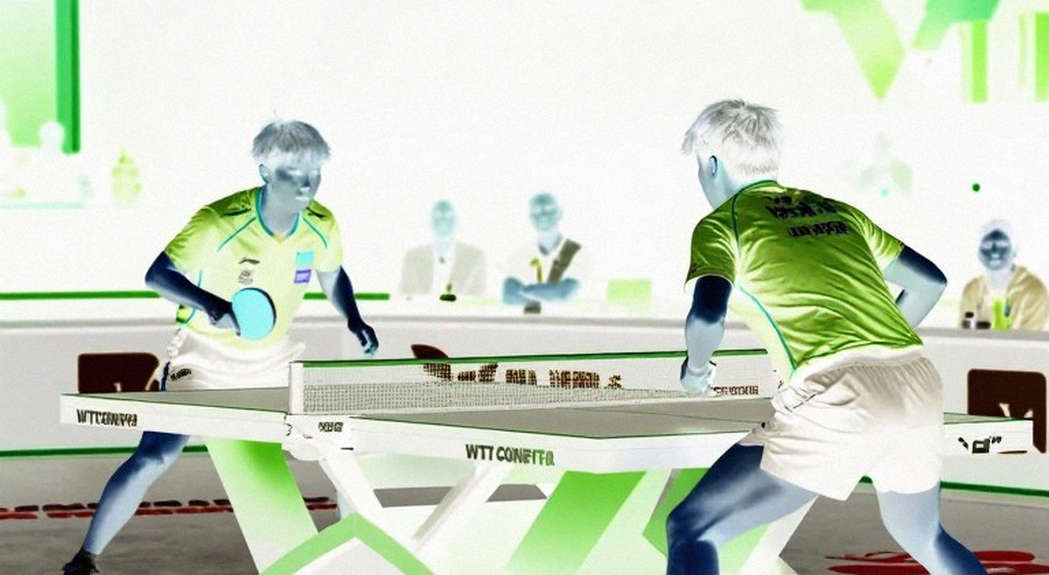
Let me set the context clearly. Vietnamese table tennis has long lived off two things: SEA Games medals in team events, and national youth tournaments that together run for less than two weeks a year. There, everything is measured by gold medals and placements, not by developmental potential. I have followed four consecutive national youth tournaments, and the worry is not about technique. It is that academies are pressured to produce results immediately at the 13-15 age group, so their centers can keep their quota, their funding, their coaching positions.
Beneath the dust of time, there are still gems no one has bothered to pick up. Bao Long is one. But what kept me there until seven in the evening to watch the whole match was not that backhand counter-loop, it was the way he moved when there was no ball.
In Vietnam, very few youth coaches teach students to think about the distance between the body and the table when the opponent is about to serve. Long did that by instinct. He stood tall, relaxed his shoulders, and always kept his weight between his feet, so he could step sideways with the left foot before swinging. That technique sounds dry, but it decides a whole career. Anyone who has played table tennis long enough knows: points are not lost to the opponent's loop, they are lost to a foot placed half a step wrong.
Long's biggest strength is on the backhand. His counter-loop makes contact extremely early, right as the ball bounces up, giving the opponent no time to set their feet. By eye, his spin on that shot is no greater than his peers', but his release is far faster. The score does not lie in power, it lies in timing: the decisive shot is sometimes just a light touch at the right moment. I once wrote something similar about a young footballer, and a coach messaged me: this is not a matter for one sport alone.

But if that were all, Long would be little different from other boys with a good left hand. What made me believe he is different was his serve. He used the same hand motion for three different spins, with contact points only millimeters apart. In the fourth game, he served six balls in a row and the opponent misread five. When football goes silent, I can hear its true heartbeat; the same is true of table tennis. The valuable thing is not the sound of the ball bouncing, but the silence before he sinks down to serve, when the racket tip has not moved at all.
Tactics are only the shell; inside is the story of a person. And Long's story has a crack I only discovered after the match, when I sat talking with him in the corridor of the arena. Two years ago, Long was cut from the youth squad of a major center in the north, not because he lost to anyone, but because he was seven centimeters below that center's physical standard. He went back to Binh Duong, trained with a retired coach, lived with the coach's family, and every morning cycled seventeen kilometers to the arena. The silence in his career lasted nearly a year, a year in which no tournament listed his name.
That is why I do not write this as a fairy tale. Because if Long succeeds, people will again praise the center that discarded him, not the old coach in Binh Duong.
We have a system that reads talent with a measuring tape and a results sheet, then takes pride in having found the best. But table tennis is not a sport of physique. It is a sport of timing and footwork. A short boy, if he has early contact and can read spin, will go further than a tall boy who only knows how to smash straight. I have said this many times in youth coaching classes, and I still get the familiar reply: there is no budget to wait.
Pressure does not kill an academy, it exposes the academy's true nature. The pressure of results makes people choose the big-bodied kid over the one with the right timing, choose a gold at 13 over footwork that can last until the Asian Games. People look at the price tag, and an anatomy shows that sometimes an entire generation is crossed out. I have seen this in football, in academies that buried so many dreams just by counting medals and forgetting to nurture. Vietnamese table tennis is repeating that exact circle, only the table is smaller so fewer people see it.

The data I recorded myself across the last four youth tournaments shows a paradox: while total registered athletes rose steadily each year, the number who appeared in three consecutive editions fell. That means we are using a large number of people to filter out very few, and filtering by the wrong criteria. At the level after the youth tournament, only a small share of those who once reached the semifinals stay with the sport after two years.
I have no official data to assert this for the whole country, so I only tell what my own eyes saw. And what I saw is many boys and girls with good technique leaving the table not because they lost, but because they were placed in the wrong slot.
No silence is meaningless, we are simply not patient enough to hear it. In Long's case, the silence was a year of being abandoned at fourteen, training alone with an old coach and counting each ball hitting the wall. If the national team looks at that year's results sheet, he does not exist. If they look at his serve motion, he is one of the most watchable young players I have ever seen at a domestic arena.
The final ended with Long winning three straight games after trailing. He did not shout, did not turn to the stands, just lowered his head to pick up the ball and walked to shake his coach's hand before shaking the referee's. That is the detail I keep, not the gold medal. Because a gold at 15 may mean nothing by the time he is twenty, but that bow of the head does.
If you ask me Long's probability of success, I will not give a number. I will only say this: a table tennis nation only improves when it starts reading talent by the feet instead of by the medal, by the silence instead of by the gold sheet. And if we keep answering the question of whether this child is tall enough, then many more gems will lie still under the dust, waiting for someone patient enough to bend down and pick them up.
The question I leave for those who run our table tennis is not how to win more medals. It is: how many more children will have to cycle seventeen kilometers each morning, just to prove that they are not as short as a measuring tape says?